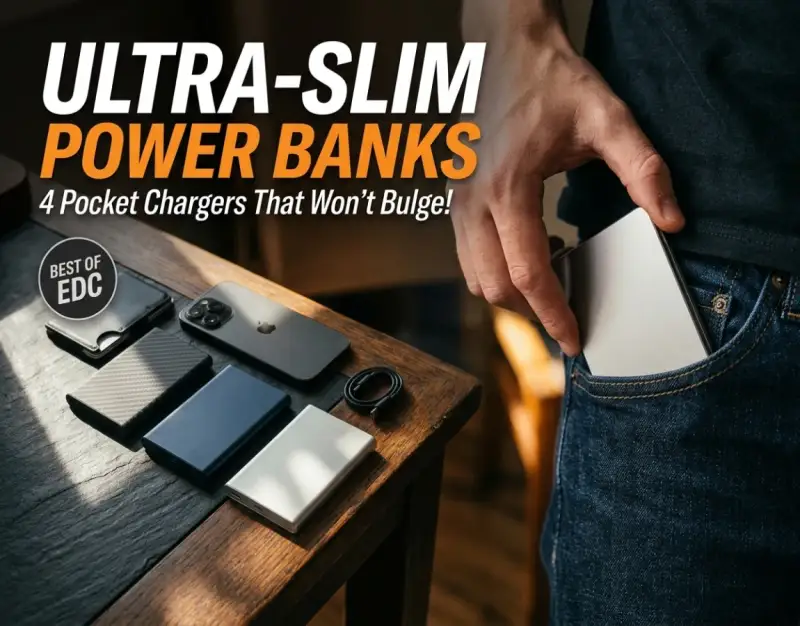
For over a decade, mobile power solutions have forced a frustrating compromise upon the modern commuter, digital nomad, and everyday carry (EDC) enthusiast: trade off battery anxiety for an unsightly, uncomfortable bulge in your trousers. The classic portable charger—historically built around heavy, cylindrical 18650 lithium-ion battery cells—resembled a brick more than a refined piece of personal technology. Dropping a standard 10,000 mAh power bank into tailored denim or dress trousers meant enduring awkward tugging, ruined silhouettes, and persistent physical discomfort throughout the workday. When tethered to a phone, these bulky setups felt like holding a concrete block, making one-handed messaging or navigation an ergonomic nightmare.
However, an unprecedented revolution in materials science, thermal dissipation engineering, and energy storage density has reshaped the portable power market. The rise of high-density silicon-anode lithium-polymer (LiPo) pouch cells, alongside ultra-efficient Indium Gallium Nitride (GaN) micro-controllers, has ushered in an era of true slimness. Modern mobile electronics no longer require massive chassis footprints to store meaningful electrical capacity. Today, an elite tier of ultra-slim battery packs can slide into a coin pocket, front pocket, or inner jacket sleeve without disrupting your garment's drape or adding noticeable strain.
In this authoritative guide, we conduct an exhaustive, evidence-based deep dive into the engineering mechanics, real-world performance, and design paradigms of modern pocket power. We analyze the technical breakthroughs that make ultra-thin battery technology possible, evaluate the exact performance metrics of four distinct slim charger architectures, and provide an actionable blueprint for choosing an ultra slim power bank that seamlessly integrates into your daily carry workflow without weighing you down.
Foundational Principles & Physics of Ultra-Slim Mobile Charging
To evaluate a thin pocket battery effectively, one must first understand the fundamental engineering constraints that governed legacy power banks for decades—and how breakthrough physics solved them. The primary metric governing power bank design is volumetric energy density, expressed in Watt-hours per Liter ($Wh/L$). Traditional cylindrical lithium-ion cells (such as the ubiquitous 18650 and larger 21700 formats) offer excellent gravimetric density (energy per weight), but their rigid circular shape creates dead air space when stacked together inside a rectangular enclosure. This volumetric inefficiency forces manufacturers to expand casing dimensions, resulting in thick, boxy profiles.
By contrast, modern ultra-thin chargers utilize specialized Lithium-Polymer (LiPo) pouch cells or advanced silicon-anode matrix structures. Pouch cell technology replaces the rigid steel outer shell of cylindrical batteries with a flexible, vacuum-sealed aluminum-laminated film. This architecture allows chemical engineers to manufacture flat, rectangular power cells as thin as 3 millimeters. When paired with high-frequency micro-printed circuit board (PCB) layouts and ultra-thin copper heatsinks, the result is a card sized portable charger that approaches the thickness of a few stacked credit cards while maintaining structural stability.
Form Factor & Energy Density Evolution: Cylindrical Cells vs. High-Density LiPo Pouches
However, reducing volumetric thickness introduces severe thermal engineering challenges. Electrical resistance inside a battery during charge and discharge cycles generates heat ($P = I^2 R$). In a thick power bank, heat dissipates through three dimensions across a relatively large surface volume. In an ultra-slim enclosure, thermal dissipation is constrained to a narrow profile, increasing the risk of thermal throttling—where the power bank's internal Management System (BMS) forcibly reduces output wattage to protect components from overheating. To overcome this, top-tier slim power banks utilize graphite thermal sheets, anodized aluminum outer shells that act as passive heatsinks, and dynamic temperature monitoring algorithms that maintain fast-charging protocols without triggering high-temperature safeguards.
Finally, energy conversion efficiency plays a critical role in small-footprint charging. Power banks operate internally at a nominal chemical cell voltage (typically 3.7V to 3.85V), but must step up this voltage to standard USB Power Delivery (USB-PD) output levels (5V, 9V, or 12V) via an internal boost converter. In inexpensive chargers, inefficiency in this step-up process converts valuable energy directly into wasted heat—reducing usable capacity by up to 40%. Premium pocket chargers employ high-efficiency DC-DC synchronous step-up converters that operate above 90% efficiency, maximizing the exact amount of charge delivered to your smartphone while keeping external touch temperatures completely safe for pocket storage.
Step-by-Step Strategic Blueprint: Selecting & Optimizing Pocket Power
1. The Chemistry & Structural Architecture Behind Modern Slim Chargers
Silicon-Anode & Advanced Lithium-Polymer Form Factors
The foundation of any genuine ultra slim power bank lies in its chemical composition. Standard lithium-ion batteries rely on graphite anodes, which have a theoretical maximum capacity ceiling. Next-generation pouch cells incorporate silicon-graphite composite anodes. Silicon offers a theoretical lithium storage capacity up to ten times greater than graphite alone. By embedding nano-silicon structures within the graphite matrix, battery engineers achieve a dramatically higher volumetric energy density ($Wh/L$), enabling a battery pack to store 5,000 mAh of charge in a footprint that previously could only hold 3,000 mAh.
Furthermore, the physical construction of these pouch cells utilizes a stacked cathode-separator-anode layer technique rather than the traditional spirally wound ("jelly-roll") method used in round batteries. Stacked layers eliminate dead internal spaces at the corners of the battery casing, yielding a flat profile that resists mechanical stress and minimizes thickness down to sub-10mm boundaries.
Thermal Management Without Mechanical Fans
Because ultra-thin chargers are designed to sit inside tight denim pockets or suit jackets, active cooling fans are structurally impossible. Heat management must occur entirely through passive conductive and radiative pathways. Leading manufacturers implement a layered thermal chassis: microscopic synthetic graphite sheets are laminated directly against the internal lithium pouch cell, spreading localized hot spots evenly across the entire surface area of the exterior casing.
This aluminum or magnesium-alloy exterior shell serves dual purposes: structural protection against bending forces (preventing accidental puncture of the lithium cell) and an active thermal radiator. By radiating heat across a broad metal surface, the internal temperature of an EDC phone charger remains well below critical thresholds ($
Be the first to share a gentle reflection on this story.