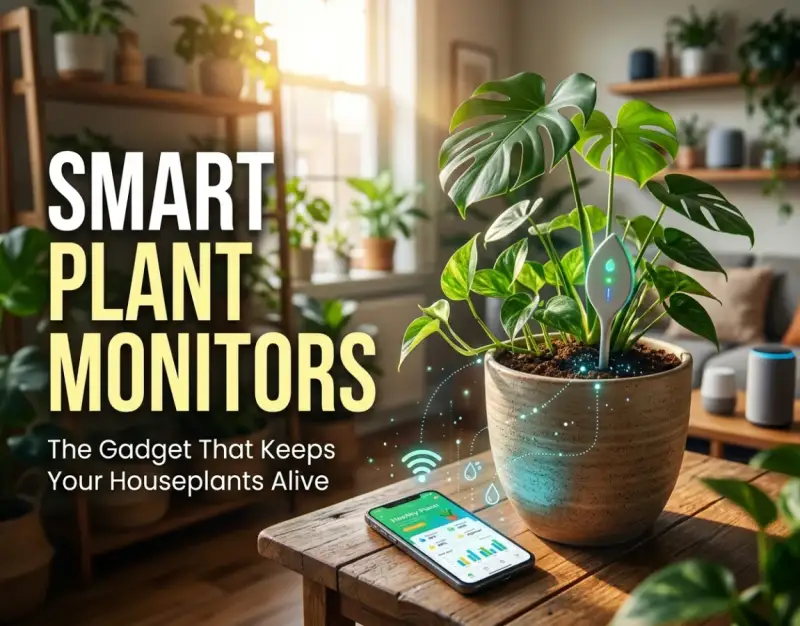
There is an unspoken tragedy that plays out in living rooms and home offices across the globe every single day: the slow, agonizing decline of a beloved fiddle-leaf fig or a once-vibrant pothos. Despite our best intentions, human intuition is notoriously ill-equipped to decipher the silent biological distress signals of potted flora. We touch the surface soil, find it dry, and reach for a watering can—unaware that the root zone inches below is already drowning in an anaerobic swamp. Alternatively, we forget our leafy companions for weeks, subjecting them to severe drought stress until their leaves turn crisp and brown. This perpetual cycle of overwatering and neglect has long been the primary Achilles' heel of urban indoor gardening.
Fortunately, the convergence of Internet of Things (IoT) hardware, advanced micro-sensors, and smart home automation has fundamentally rewritten the rules of indoor cultivation. Enter the modern smart plant monitor—a sophisticated piece of digital botany that bridges the communication gap between human and houseplant. By continuously tracking critical subterranean and ambient environmental vectors such as volumetric soil moisture, electrical conductivity, ambient light intensity, and temperature, these pocket-sized diagnostic tools strip the guesswork out of plant husbandry. No longer do urban gardeners need to rely on the unreliable 'finger test' or guesswork; instead, actionable telemetry streams directly to our smartphones, transforming passive plant ownership into an exact, data-driven science.
As smart living ecosystems expand to encompass every facet of our daily routines, integrating digital sensors into our living spaces has become just as essential as streamlining our mobile workstations with tools like Magnetic Phone Mounts for Laptops: Dual-Screen Productivity on the Go. This comprehensive guide explores the mechanics, strategic deployment, real-world execution, and advanced nuances of utilizing smart plant monitors to cultivate thriving indoor jungles with absolute confidence.
Foundational Principles and Mechanics of Smart Plant Monitors
To truly master the deployment of an indoor plant care gadget, one must first understand the underlying physics and bio-sensing mechanics that allow these devices to translate biological environments into digital data. Unlike basic analog moisture meters—which often rely on galvanic corrosion between dissimilar metals to yield erratic readings—modern smart monitors utilize capacitive sensing arrays. Capacitive sensors measure the dielectric permittivity of the surrounding soil matrix. Because water has a significantly higher dielectric constant than air and dry soil minerals, changes in soil moisture directly alter the capacitance. This methodology eliminates electrode degradation, ensuring long-term measurement accuracy without leaching heavy metals into the root zone.
Beyond moisture detection, comprehensive plant monitors evaluate electrical conductivity (EC) to gauge soil fertility. By applying a controlled micro-current through the soil between two electrodes, the device measures total dissolved solids (TDS) and ionic nutrient concentrations. If the EC reading dips below a specific threshold, it signals that macronutrients like nitrogen, phosphorus, and potassium (NPK) have been depleted. Simultaneously, integrated phototransistors or digital light sensors measure Photosynthetically Active Radiation (PAR) or general lumens, verifying whether a low-light tropical plant is languishing in deep shadow or frying under harsh artificial rays. All of this telemetry is processed by onboard microcontrollers and transmitted via Bluetooth Low Energy (BLE) or Wi-Fi to centralized cloud databases and user applications.
Anatomy of a Smart Plant Monitor Ecosystem
Hardware Architecture and Probe Design
The physical engineering of a high-end smart plant monitor demands a delicate balance between rugged durability and extreme miniaturization. The probe prongs must be manufactured from corrosion-resistant materials such as medical-grade stainless steel or gold-plated alloys to withstand prolonged exposure to acidic soils, moisture, and chemical fertilizers. The electronic housing unit, which sits just above the soil line, must feature an IP rating (typically IPX5 or higher) to protect sensitive chipsets from accidental overspray during watering routines or high humidity environments.
Power efficiency remains another masterclass in hardware design. Because these devices reside deep within plant pots where manual battery swaps are inconvenient, they rely on ultra-low-power microcontrollers and coin-cell batteries (such as CR2032) or small rechargeable lithium-ion cells. By utilizing duty-cycling—waking up every 15 to 60 minutes to take a reading and immediately returning to a deep sleep state—quality monitors can achieve battery lifespans ranging from six months to over a full year on a single charge. This engineering mirrors the reliability demanded in everyday carry tech, much like equipping your workspace with Pocket Multi-Tool Pens: 4 Everyday Carry Writers With Built-In Tech Tools for seamless on-the-go utility.
Software Integration and Plant Database Mapping
Hardware is merely the collector of raw telemetry; the true power of a smart plant monitor lies within its companion software ecosystem. Mobile applications associated with these devices maintain massive botanical databases containing thousands of species profiles. When a user registers a new device, they select their specific plant variety—whether it is a delicate Calathea or a hardy Sansevieria—from an exhaustive catalog containing precise environmental thresholds.
The software acts as a real-time translating engine. It takes the raw capacitance, EC, and lux data and measures them against the hardcoded biological requirements of that specific cultivar. If a Monstera deliciosa requires soil moisture between 30% and 50%, an ambient temperature of 65–85°F, and bright indirect light, the application continuously calculates real-time delta values. When metrics breach these predefined parameters, the system triggers push notifications, alerting the user to immediate corrective actions before visual symptoms like chlorosis or wilting manifest.
Step-by-Step Deployment Strategy for Indoor Plant Monitors
Step 1: Selecting the Ideal Monitor Placement
The physical positioning of your soil moisture sensor dictates the accuracy of your diagnostic data. Inserting the probe too close to the ceramic or plastic pot wall can result in false moisture readings due to condensation and air pockets that naturally form along container perimeters. Conversely, placing the sensor directly against the main woody stem of a mature plant can risk physical damage to the primary root structure.
The optimal placement strategy is to insert the prongs midway between the outer rim of the pot and the base of the plant stem, sinking them vertically until the base of the plastic housing rests flush with the soil surface. Ensure that the sensor penetrates deep enough into the root ball zone where the fine feeder roots—the primary absorbers of water and nutrients—are concentrated. For exceptionally deep pots, choose a monitor with extended prongs to capture root-zone data at varying depths rather than just the topsoil layer.
Step 2: Calibration and Initial Baseline Sync
Once physically installed, the smart monitor requires a stabilization period to acclimate to its new subterranean environment. Dry soil settling, micro-gaps around the metal prongs, and initial irrigation variances can cause erratic telemetry during the first 24 hours of deployment. Refrain from making immediate watering adjustments right after installation.
Open your companion mobile app, select the exact species profile, and execute a manual sync to establish a baseline reading. Many advanced apps feature a calibration wizard that prompts you to water the plant thoroughly until runoff occurs, then monitors the dry-down curve over several days. This custom learning algorithm adapts to your specific potting mix composition—whether it is a fast-draining orchid bark mix or a moisture-retentive peat and perlite blend—ensuring hyper-accurate future triggers.
Step 3: Integrating with Smart Home Automation Ecosystems
To transition from passive monitoring to true home automation, link your smart plant monitor to broader IoT ecosystems such as Apple HomeKit, Google Home, Amazon Alexa, or Home Assistant via local APIs or bridge hubs. While most plant sensors communicate via Bluetooth, smart bridges can relay this data to cloud routines or local automation servers.
Configuring advanced conditional logic elevates your indoor garden management. For example, you can program an automation where a smart LED grow light automatically increases its photoperiod or brightness intensity whenever the monitor's light sensor detects consecutive cloudy days. Similarly, integration with smart water pumps or automated drip irrigation valves can deliver precise micro-doses of water the exact moment soil volumetric water content drops below the critical wilting point.
Advanced Customization and Multi-Zone Plant Management
Managing Micro-Climates in Urban Apartments
Urban indoor spaces present unique environmental hurdles, including dry forced-air heating in the winter and intense solar radiation pouring through untreated south-facing windows in the summer. A single room can harbor multiple distinct micro-climates, drastically affecting how quickly individual plant pots dry out.
Deploying a fleet of smart plant monitors across different zones allows you to map your apartment's thermodynamic and hygrometric profile. You may discover that identical plants placed on a high bookshelf dry out 40% faster than those sitting on a low media console due to convection currents and ceiling heat accumulation. Armed with this granular data, you can strategically relocate species to environments that match their natural habitat requirements, drastically improving overall vitality.
Data Logging and Long-Term Health Analytics
Beyond day-to-day watering reminders, premium plant monitor applications offer comprehensive historical charting. Reviewing weekly and monthly graphs provides invaluable insights into seasonal dormancy phases. During winter months, many houseplants naturally slow their metabolic activity, resulting in significantly reduced water consumption.
By analyzing the dry-down slope over time, you can preemptively adjust your maintenance schedule before overwatering occurs. Furthermore, tracking EC (nutrient) levels over a multi-month period helps you optimize your fertilization regimen, preventing fertilizer burn caused by salt accumulation in the soil while ensuring that hungry tropicals never experience nutrient lockout.
Real-World Case Studies & Scenarios
Scenario A: The Corporate Office Ficus Failure
The Challenge: A prominent downtown marketing firm installed ten large ficus trees in their open-plan office. Maintained by a rotating roster of well-meaning employees who watered them 'whenever the topsoil felt dry,' seven of the ten trees suffered catastrophic leaf drop and root rot within three months.
The Intervention: Facility managers deployed industrial-grade smart plant monitors into the remaining root balls, syncing them to a centralized tablet dashboard monitored by the office manager. The app revealed that the office's aggressive HVAC system was creating rapid surface evaporation, making the top inch of soil bone dry while the lower root zone remained saturated at 85% volumetric moisture.
The Outcome: By adhering strictly to the capacitive moisture sensor thresholds rather than visual topsoil cues, the team allowed the root zones to dry out properly. Within six weeks, new foliage emerged, and zero additional trees were lost, saving the firm hundreds in replacement costs.
Scenario B: The Rare Aroid Collector's Sanctuary
The Challenge: An enthusiast collector housing rare, high-value variegated aroids (such as *Monstera albo* and *Philodendron pink princess*) struggled with inconsistent humidity and watering cycles, risking root rot on specimens valued in the hundreds of dollars per cutting.
The Intervention: The collector integrated Bluetooth-enabled smart plant monitors into every specialized semi-hydroponic and soil-based pot, utilizing custom alerts tuned to strict minimum moisture boundaries.
The Outcome: Root rot incidents dropped to absolute zero. The precise tracking of ambient light levels also allowed the collector to optimize shade cloth placement during peak summer months, resulting in flawless, unburned variegation and accelerated propagation success.
Critical Mistakes to Avoid When Using Smart Plant Monitors
Even the most advanced technology can fail if deployed with flawed methodologies. Avoid these five costly pitfalls to ensure optimal performance:
- Ignoring Soil Composition Variance: Assuming all potting mixes behave identically. Heavy clay-based soils hold moisture differently than airy perlite-heavy mixes. Always allow the app to calibrate to your specific substrate.
- Neglecting Sensor Maintenance: Failing to clean mineral deposits off the metal prongs. Over time, fertilizer salts encrust the electrodes, insulating them and causing severely skewed EC and moisture readings. Wipe the prongs clean every time you repot or deep-clean your plants.
- Relying Solely on Push Notifications: Treating app alerts as optional suggestions while letting critical moisture thresholds pass unaddressed for days. Automated data collection is useless without prompt human or automated intervention.
- Placing Sensors in Dead Zones: Sinking probes into compacted soil pockets or directly against drainage holes where water instantly pools or drains away, failing to capture the true moisture status of the main root mass.
- >Over-Reliance on Bluetooth Range Limits: Failing to account for physical obstructions like thick concrete walls or heavy furniture that block BLE signals from reaching your smartphone or hub, resulting in silent data gaps. For larger setups, always ensure you use signal repeaters or Wi-Fi-enabled bridge nodes.
Comprehensive Comparison Table: Traditional Care vs. Smart Plant Monitoring
| Diagnostic Parameter | Traditional Manual Care | Smart Plant Monitor Approach |
|---|---|---|
| Moisture Assessment | Subjective finger test; prone to misreading deep root hydration. | Real-time capacitive dielectric measurement of exact root-zone water content. |
| Nutrient Tracking | Guesswork based on arbitrary calendar schedules (e.g., 'feed monthly'). | Continuous Electrical Conductivity (EC) monitoring of ionic salt and mineral levels. |
| Light Measurement | Visual estimation of room brightness; highly inaccurate for plant needs. | Precise PAR and lux sensors calculating cumulative daily light absorption. |
| Failure Rate | High risk of overwatering, root rot, and nutrient burn among urban owners. | Near-zero guesswork, proactive alerts, and prolonged plant longevity. |
| Ecosystem Integration | Completely manual; disconnected from smart home routines. | Seamless integration with smart lighting, automated watering pumps, and voice assistants. |
Frequently Asked Questions (FAQ)
Do smart plant monitors require a continuous Wi-Fi connection?
Most consumer-grade smart plant monitors utilize Bluetooth Low Energy (BLE) to conserve battery life. This means the device stores readings locally and syncs them to your smartphone whenever you are within Bluetooth range (typically 10 to 30 feet). However, advanced models often offer optional Wi-Fi hub bridges that allow remote monitoring from anywhere in the world, enabling you to check your indoor garden's status while traveling.
Can I leave the same sensor in the soil permanently, or will it rust?
High-quality plant monitors are engineered for long-term subterranean deployment. Their probes are constructed from oxidation-resistant materials such as stainless steel, industrial plastics, or gold-plated alloys designed to withstand constant moisture and acidic soil fertilizers for years. However, it is always best practice to gently remove and wipe down the probes during routine repotting or every six months to clear away accumulated fertilizer salts.
How do smart monitors handle different potting soil mixtures?
Potting substrates vary wildly in water retention. A dense mixture of garden soil and compost retains moisture differently than an airy orchid mix composed of bark, perlite, and charcoal. Premium smart plant monitor apps feature calibration profiles that adjust the algorithm based on the soil medium you select during setup, ensuring accurate volumetric moisture calculations regardless of the substrate.
Will these sensors tell me when my plant needs repotting?
While sensors do not explicitly measure root-bound status, they provide indirect telemetry that strongly hints at it. If you notice that your smart monitor records that soil moisture drops from 100% to 0% in a matter of 24 to 48 hours consistently, despite normal ambient temperatures, it is a definitive physical indicator that the root mass has completely displaced the soil, leaving virtually no substrate to retain moisture. This serves as your cue to upgrade to a larger pot, ensuring your everyday carry setup—from your desktop gear to your living room flora—operates with maximum efficiency just like keeping an Ultra-Slim Power Banks: 4 Pocket Chargers That Won't Bulge in Your Jeans ready for action.
Strategic Roadmap and Final Takeaway
The evolution of indoor cultivation has definitively crossed the threshold from intuitive art form to precise, data-driven science. As smart home automation continues to mature over the next two to five years, we will see an even deeper integration of artificial intelligence within horticultural tech. Future smart plant monitors will likely feature machine learning algorithms that autonomously diagnose pest infestations before symptoms appear, predict growth spurts based on historical telemetry, and communicate directly with automated micro-irrigation systems to maintain flawless hydration without human intervention.
To future-proof your indoor garden today, begin by auditing your current plant inventory and identifying your most vulnerable or high-value specimens. Integrate precision soil moisture sensors and smart plant care gadgets into these critical zones, calibrate your app profiles carefully, and establish a routine of responding to data-driven prompts rather than relying on guesswork. By embracing this technological shift, you eliminate the heartbreak of preventable plant loss, turning your home into a thriving, self-sustaining botanical sanctuary.
Be the first to share a gentle reflection on this story.