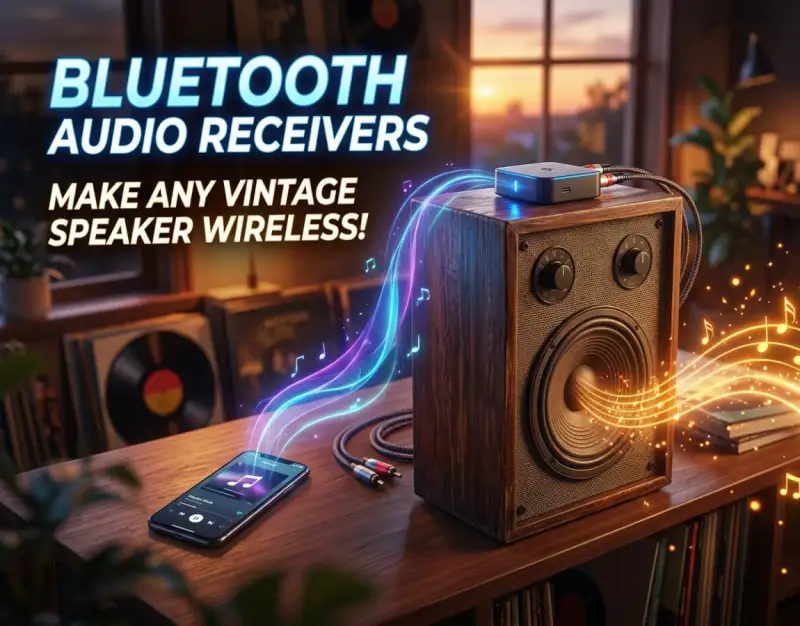
There is a profound, irreplaceable tactile satisfaction found in dropping a needle onto a vintage vinyl record, sliding the heavy brass-trimmed volume dial of a 1970s receiver, and listening to warm, room-filling sound cascade from heavy wood-cabinet speakers. For decades, audiophiles and design purists have sworn by the superior acoustic construction and timeless aesthetic of mid-century and late-century stereo equipment. These analog powerhouses were built to last, engineered with discrete components, hefty transformers, and solid-state or tube topologies that modern, mass-produced plastic soundbars simply cannot replicate. Yet, in an era where our entire music libraries, high-resolution streaming subscriptions, and podcasts live inside our smartphones, tablets, and laptops, keeping these legendary sound systems tethered exclusively to physical media or cumbersome auxiliary cables creates a frustrating friction point between historical appreciation and modern convenience.
Enter the contemporary renaissance of retro-fitting. Today’s consumers no longer have to choose between the pristine acoustic signature of vintage gear and the frictionless agility of wireless streaming. Across living rooms, creative studios, and minimalist workspaces, enthusiasts are discovering that bridging this generational gap does not require replacing treasured hardware or navigating complex, invasive rewiring jobs. By integrating a high-fidelity Bluetooth audio receiver into an existing setup, you can effortlessly modernize your legacy sound system without altering its authentic aesthetic or compromising its sonic integrity. This technological bridge acts as a silent translator, taking digital packets beamed from your pocket device and converting them into pristine analog signals ready to be amplified by vintage warmth.
This comprehensive guide explores the mechanics, strategies, and nuances of transforming your classic audio hardware into a fully functional modern streaming ecosystem. Whether you are looking to revitalize a inherited stereo console, upgrade a garage workshop amp, or integrate a classic bookshelf setup into a whole-home multi-room audio configuration, mastering the art of the wireless adapter for speakers will redefine how you experience sound. As we dive into the technical principles, hardware selection matrices, and step-by-step installation blueprints, you will learn how to honor the past while embracing the absolute pinnacle of contemporary audio flexibility.
Understanding the Anatomy of Vintage Audio and Wireless Integration
The Analog-Digital Divide: Why Vintage Gear Sounds Better
To truly understand why upgrading a vintage sound system is worth the effort, one must examine the fundamental philosophy governing historic audio engineering. Vintage amplifiers, receivers, and speakers were designed during an era when hardware components were over-engineered to compensate for manufacturing tolerances. Heavy-gauge wiring, discrete transistors, and analog crossover networks yielded a dynamic range and harmonic distortion profile that favored natural warmth and depth over clinical, hyper-compressed digital precision. When you pipe modern lossless audio streams through these analog circuits, the results are often breathtakingly rich, characterized by a smooth midrange and a non-fatiguing soundstage.
However, this analog paradise comes with a modern catch: inputs. Traditional amplifiers rely on RCA phono stages, tape loops, and auxiliary lines designed for physical decks, CD players, or tuners. They know nothing of Bluetooth profiles, Wi-Fi casting, or USB audio classes. Attempting to connect a modern smartphone directly to a vintage amp usually hits a wall of incompatible physical connectors and mismatched impedance levels. Bridging this divide requires an intermediary device that speaks both fluent digital (Bluetooth) and classic analog (RCA or 3.5mm auxiliary), turning your legacy gear into a hybrid powerhouse.
Decoding Bluetooth Audio Profiles: SBC, AAC, aptX, and LDAC
Not all wireless connections are created equal. When shopping for an aux Bluetooth adapter, you will encounter a alphabet soup of codec acronyms that dictate sound quality, latency, and connection stability. Understanding these codecs is essential to ensuring your vintage speakers do not become bottlenecked by low-bandwidth wireless transmission. The standard baseline codec, SBC (Subband Coding), is universally supported but aggressively compresses audio, often introducing high-frequency artifacts and a muddy soundstage.
For Apple device users, AAC (Advanced Audio Coding) provides significantly better efficiency and fidelity over Bluetooth. Meanwhile, Android users and audiophiles looking for near-lossless transmission should seek out hardware supporting Qualcomm aptX, aptX HD, or Sony’s LDAC. These advanced codecs allow higher bitrates to pass through the airwaves with minimal latency and degradation. When paired with a dedicated receiver, these high-end codecs ensure that the high-resolution files streaming from your phone retain every ounce of transient snap and acoustic detail before hitting your amplifier's inputs.
Active vs. Passive Speakers: Mapping Your Signal Flow
Before purchasing any hardware, you must accurately diagnose your current speaker setup. Audio gear generally falls into two distinct categories: passive speakers and active (powered) speakers. Passive speakers have no internal amplification; they require raw speaker wire running directly from the speaker terminals of a stereo receiver or integrated amplifier. If your vintage setup consists of passive wood-cabinet speakers connected to a heavy receiver, your Bluetooth receiver will plug directly into an auxiliary input on the receiver itself, letting the vintage amp do the heavy lifting of powering the speakers.
Conversely, active vintage speakers—often found in vintage studio monitors or specialized multimedia setups—feature built-in amplifiers and plug directly into wall power. For these systems, you will connect your wireless adapter straight into the speaker's line-in port. Accurately mapping this signal flow prevents impedance mismatches, safeguards your vintage drivers from clipping or distortion, and ensures optimal gain staging throughout your entire listening environment. Much like curating your desktop workspace with Custom Coiled Aviator Cables: The Aesthetic Upgrade Your Mechanical Keyboard Needs to balance vintage mechanical aesthetics with modern connectivity, matching your audio gear correctly preserves both form and function.
Selecting the Right Bluetooth Receiver for Your Setup
Input/Output Connectivity Options: RCA, Optical, and 3.5mm
The success of your retro-fit project hinges entirely on physical compatibility. When evaluating potential wireless adapters, examine the rear panel of your vintage amplifier or active speakers to determine what inputs are available. The gold standard for vintage audio integration is dual RCA (Red/White stereo plugs). A receiver with stereo RCA outputs allows you to use high-grade, shielded analog cables to bridge the adapter directly into a spare "AUX," "TAPE," or "CD" input on your classic amplifier.
Some advanced vintage or hybrid stereos also feature digital optical (TOSLINK) inputs, especially if they are mid-90s digital-ready receivers. If your hardware features an internal DAC (Digital-to-Analog Converter) that you prefer over the converter inside a cheap Bluetooth dongle, look for a receiver with optical or coaxial digital outputs. For smaller vintage boomboxes, portable stereos, or active computer speakers, a standard 3.5mm auxiliary jack output on the adapter will be your primary point of entry. Always prioritize adapters built with robust metal chassis rather than cheap plastic housings to eliminate electromagnetic interference and ground loop hum.
Power Delivery and Ground Loop Isolation
Power management is the silent killer of clean vintage audio. Many budget Bluetooth adapters rely on cheap
Be the first to share a gentle reflection on this story.