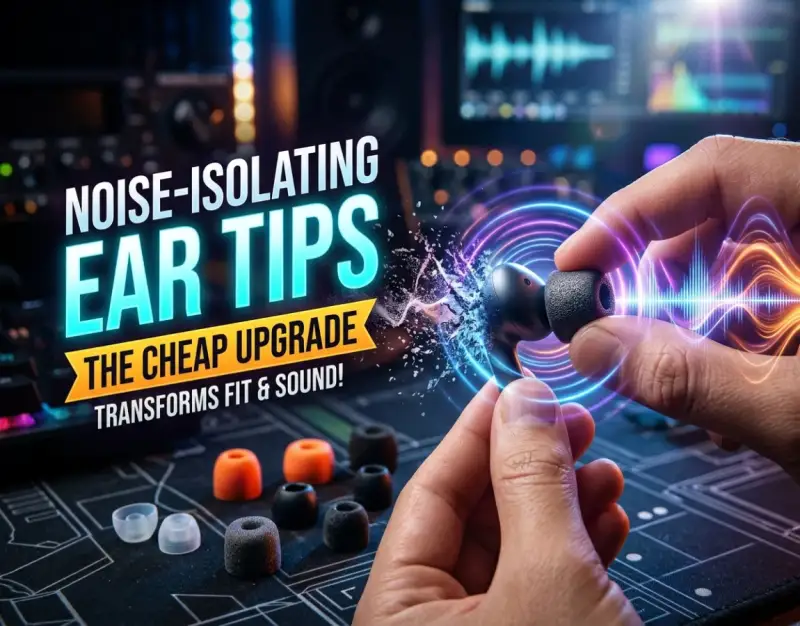
For decades, the consumer audio market has operated on a foundational, highly profitable contradiction: manufacturers spend millions of dollars engineering microscopic dynamic drivers, complex acoustic chambers, and sophisticated active noise-cancelling (ANC) digital signal processors, only to bundle these precision instruments with generic, one-size-fits-most silicone tips. Millions of listeners around the world routinely purchase premium wireless earbuds—investing hundreds of dollars in flagship hardware—only to experience loose fits, hollow sound signatures, and constant intrusive background noise during their daily commutes. The root cause of this persistent frustration is rarely the speaker driver or the Bluetooth codec; rather, it is the physical seal between the ear canal and the earbud itself.
When an earbud fails to achieve an airtight, anatomically secure acoustic seal, physics dictates a massive degradation in performance. Low-frequency bass waves escape into the open air, external ambient noise leaks directly into the cochlea, and the active noise-cancelling microphones become overwhelmed by unblocked acoustic pathways. Fortunately, everyday carry enthusiasts and audiophiles alike have latched onto a transformative revelation: you do not need to buy a brand-new set of headphones to radically alter your listening experience. Upgrading to specialized memory foam ear tips represents one of the most cost-effective, high-impact modifications available in modern personal technology, instantly resolving issues that often plague even the most expensive flagship earbuds on the market.
This comprehensive investigation explores the deep acoustic, mechanical, and ergonomic science behind passive noise isolation and custom earbud interfaces. Beyond simply reviewing a product category, this guide provides a step-by-step strategic blueprint for maximizing your audio gear, evaluating compatibility, preventing common installation errors, and optimizing your daily listening setup. Whether you are navigating noisy open-plan offices, enduring transatlantic flights, or trying to secure your earbuds during grueling high-intensity workouts, understanding the mechanics of earbud sound isolation will permanently change how you experience portable sound. Just as modern commuters look for 10 clever tech gadgets under $30 that fix everyday frustrations, integrating professional-grade foam tips into your daily routine is an effortless, low-cost intervention that yields disproportionately massive returns.
Foundational Principles: The Physics of Acoustic Sealing and Isolation
To truly appreciate the transformative impact of aftermarket foam tips, one must first understand the fundamental acoustics governing in-ear monitors (IEMs) and true wireless stereo (TWS) earbuds. Sound is fundamentally a mechanical wave of pressure changes traveling through a medium—in this case, the air inside your ear canal. When sound travels from a tiny speaker nozzle directly toward your eardrum, any microscopic gap, leakage, or imperfect boundary condition acts as an acoustic pressure relief valve. Low-frequency sound waves, which require substantial acoustic pressure and uninterrupted containment to be fully perceived by the human ear, are the first casualties of a poor seal. Without an airtight enclosure, bass response drops precipitously, leaving the music sounding thin, harsh, and sterile.
Furthermore, passive sound isolation acts as the essential first line of defense against ambient noise pollution. Active noise cancellation relies on phase inversion—capturing external noise via microphones and generating an inverted sound wave to cancel it out—but ANC systems are notoriously inefficient at blocking high-frequency transients, sudden sharp noises, and complex erratic sounds like human speech or clattering keyboards. Passive isolation, powered by dense, energy-absorbing materials, blocks these higher frequencies entirely through sheer physical mass and obstruction. When passive isolation and active noise cancellation work in tandem, the total attenuation of ambient noise multiplies exponentially, creating a silent acoustic canvas where subtle musical details can finally shine.
The transition from standard silicone to memory foam fundamentally alters this dynamic. While silicone relies on elastic deformation—pressing against the skin with a constant, spring-like tension that often causes hot spots, soreness, and eventual slippage as facial muscles move—polyurethane memory foam utilizes viscoelastic properties. Viscoelastic foam responds to both temperature and pressure, softening under body heat and slowly expanding to fill the unique, asymmetric contours of an individual's ear canal. This creates a uniform, pressure-balanced gasket that adapts dynamically to jaw movements, talking, and chewing, ensuring that the acoustic seal remains unbroken regardless of physical activity or facial expressions.
Anatomy of Aftermarket Upgrades: Materials, Densities, and Design Variations
Understanding Polyurethane Memory Foam Composition
The secret behind premium memory foam ear tips lies in the precise chemical formulation of the polyurethane foam matrix. Unlike cheap packing foam or low-density sponges, medical-grade and acoustically optimized memory foams are engineered with an open-cell structure that regulates airflow through microscopic internal channels. This controlled porosity allows the foam to compress smoothly into a fraction of its original size without creating excessive internal air pressure when inserted into the ear canal, preventing the uncomfortable "vacuum" sensation common with poor-quality designs.
When selecting aftermarket tips, density is the single most critical variable to evaluate. Lower-density foams compress effortlessly and feel feather-light upon insertion, but they often lack the structural rigidity required to maintain a robust acoustic seal against vigorous jaw movements or heavy sweat exposure. Conversely, ultra-high-density foams offer maximum passive noise attenuation and formidable durability, but they require a longer "break-in" compression time and may feel overly firm during extended multi-hour listening sessions. Finding the optimal balance between compliance and structural recovery speed is essential for long-term comfort and consistent acoustic performance.
The Integration of Wax Guards and Acoustic Meshes
A frequent point of failure for high-end true wireless earbuds is the accumulation of cerumen (earwax) inside the delicate speaker nozzles. Premium memory foam ear tips frequently incorporate integrated wax guards—fine acoustic meshes or physical barriers positioned at the core opening of the tip—to prevent particulate matter from migrating into the earbud's internal drivers. These protective screens are engineered not only to safeguard your hardware investment but also to maintain an unobstructed acoustic path for high-frequency sound transmission.
When evaluating tips with integrated mesh filters, it is crucial to inspect the aperture size relative to your earbud's sound output nozzle. An improperly matched mesh can introduce unwanted acoustic impedance, dampening treble response or altering the manufacturer's carefully tuned frequency curve. High-end aftermarket manufacturers design their acoustic filters to be acoustically transparent, ensuring that the enhanced bass response and improved passive isolation do not come at the expense of midrange clarity or high-end sparkle.
Core Compatibility and Mechanical Locking Mechanisms
True wireless earbuds present a unique engineering challenge because charging cases impose strict dimensional limitations on accessory design. Unlike traditional wired IEMs with standardized cylindrical nozzles, modern wireless earbuds feature proprietary, non-circular nozzle shapes (such as oval designs found on popular flagship models) and precise depth tolerances to ensure the earbuds can dock properly and charge inside their protective cases without manual removal of the tips.
To accommodate these diverse hardware architectures, advanced aftermarket tips utilize flexible inner cores made of medical-grade silicone or specialized polycarbonate adapter rings. These core systems feature mechanical locking ribs or friction-fit ridges that grip the earbud nozzle securely, preventing the foam tip from detaching inside the ear canal during removal—a notoriously frustrating mishap that can require a medical visit if not easily retrieved. Ensuring a firm mechanical bond between the earbud and the tip is just as vital as achieving a seal within the ear canal itself.
Strategic Blueprint for Optimizing Earbud Fit and Sound Isolation
Step 1: Assessing Your Current Fit and Identifying Leakage Points
Before purchasing or installing new ear tips, you must conduct a rigorous audit of your current acoustic seal. Put on your earbuds, play a dynamic audio track featuring prominent sub-bass frequencies (such as acoustic upright bass or electronic synth drops), and gently press the exterior of each earbud inward toward your ear canal. If you notice an immediate, dramatic increase in bass weight and a sudden drop in room noise, your current silicone tips are failing to create an adequate seal.
Pay close attention to how your ears react during physical movement. Do the earbuds slowly migrate outward when you talk, smile, or chew? Do you find yourself constantly readjusting them during workouts or morning commutes? Documenting these specific failure points allows you to choose the correct foam tip profile—whether you need a standard cylindrical shape for deep insertion, a tapered conical design for shallow canals, or an ultra-short profile tailored specifically for compact charging case compatibility.
Step 2: Selecting the Correct Size and Shape Profile
One of the most common mistakes consumers make when transitioning to memory foam tips is assuming they require the exact same size designation (Small, Medium, Large) that they used with stock silicone tips. Because memory foam compresses significantly during insertion and expands to fill irregular geometries, sizing dynamics operate under an entirely different set of physical rules.
When in doubt, purchase a multi-size sampler pack rather than committing to a single dimension. A proper fit should feel snug and secure without creating painful pressure points after ten minutes of wear. If a tip feels loose and lets external sound bleed in, scale up to the next size; if it feels overly aggressive, stretches the ear canal painfully, or refuses to stay compressed long enough for proper insertion, scale down. Remember that left and right ear canals are rarely identical in human anatomy; many users achieve the best results by utilizing a medium tip in one ear and a large tip in the other.
Step 3: Mastering the Proper Insertion Technique (The Roll-Compress-Insert Method)
Inserting memory foam ear tips correctly requires a distinct technique that contrasts sharply with how one inserts standard silicone tips. Simply jamming a foam tip directly into your ear canal while it is fully expanded will scrape the delicate skin, fail to achieve a proper seal, and rapidly degrade the foam's structural integrity.
Execute the following multi-stage insertion protocol for optimal performance:
- Roll: Roll the foam tip firmly between your clean thumb and index finger, compressing the material into a tight, smooth cylinder with as small a diameter as possible.
- Pull: Reach over your head with your opposite hand and gently pull upward and outward on your outer ear (pinna) to straighten and open up the ear canal.
- Insert: Promptly insert the compressed earbud into your ear canal before the foam begins to expand.
- Hold: Hold the earbud gently in place for 5 to 10 seconds while the memory foam slowly expands and conforms to your unique anatomical contours, locking into an airtight acoustic seal.
Step 4: Calibrating Software and Testing ANC Integration
Once your new foam tips are securely installed and properly seated, you must recalibrate your audio playback devices to account for the physical upgrade. Many modern wireless earbuds feature companion mobile applications equipped with an "Ear Tip Fit Test" utility. Run this diagnostic test immediately after installation to verify that the software registers a proper airtight seal across both channels.
Furthermore, evaluate how active noise cancellation interacts with your new passive isolation. Because high-frequency sounds are now aggressively blocked by the dense foam barrier, the digital ANC processors no longer need to work overtime to suppress erratic ambient noises. This reduction in processor workload can occasionally yield a minor improvement in battery life while dramatically lowering the audible "white noise hiss" often produced by aggressive digital noise-cancelling algorithms in quiet environments.
Step 5: Establishing a Maintenance and Hygiene Routine
Unlike silicone tips, which can be wiped down indefinitely with harsh chemical sterilizers or alcohol wipes without structural degradation, memory foam tips require a more delicate, intentional maintenance routine. The open-cell polyurethane structure naturally absorbs minor amounts of skin oils, sweat, and earwax over prolonged periods of use, which can eventually cause the foam to lose its viscoelastic memory properties if left uncleaned.
Establish a bi-weekly maintenance schedule by gently removing the foam tips from your earbuds and washing them in lukewarm water with a mild, fragrance-free soap. Never use harsh chemical solvents, bleach, or boiling water, as these substances will break down the polyurethane matrix and ruin the material's elasticity. Once washed, squeeze out excess moisture gently using a clean paper towel and allow the tips to air-dry completely in a well-ventilated area for at least 12 hours before reattaching them to your hardware.
Real-World Case Studies & Scenarios
Scenario A: The Frequent Flyer and Urban Commuter
The Challenge: Mark, a management consultant who flies twice weekly and navigates noisy subway systems daily, struggled with constant engine rumble and high-pitched screeching on his commute. Even with flagship noise-cancelling earbuds, the low-frequency drone of jet engines leaked past his stock silicone tips, forcing him to crank the volume to unsafe levels to hear podcasts clearly.
The Intervention: Mark upgraded to high-density memory foam tips specifically tailored for his wireless earbuds. He adopted the roll-compress-insert technique for every flight and utilized his phone's ANC settings.
The Outcome: Ambient noise attenuation improved dramatically. Jet engine roar was reduced to a faint, non-intrusive whisper, allowing Mark to lower his listening volume by nearly 40%. Audio fidelity improved instantly, with rich sub-bass recovery and crisp vocal articulation. His ears felt completely rested after four-hour flights, eliminating the fatigue and pressure headaches previously caused by poor acoustic seals.
Scenario B: The High-Intensity Endurance Athlete
The Challenge: Sarah, an avid runner and CrossFit enthusiast, found that sweat accumulation during intense workouts regularly broke the seal on her earbuds, causing them to slip out of her ears mid-stride. She was constantly pushing her earbuds back into place, interrupting her workouts and risking damage from drops.
The Intervention: Sarah switched to specialized sweat-resistant memory foam tips featuring an outer polyurethane coating designed to maintain grip when exposed to moisture. She selected a slightly larger size to compensate for dynamic jaw movement during heavy lifting.
The Outcome: The viscoelastic foam expanded to lock securely into her ear canals, creating high friction that resisted sweat lubrication and gravitational pull. Her earbuds remained firmly anchored throughout grueling interval sessions, and the enhanced passive isolation allowed her to maintain high focus without adjusting her gear once.
Critical Mistakes to Avoid When Upgrading Ear Tips
To ensure you get the absolute maximum performance and longevity out of your upgraded audio gear, avoid these five common pitfalls that trap inexperienced users:
- Mistake 1: Forcing Uncompressed Tips Into the Ear Canal. Pushing a fully expanded foam tip directly into your ear without compressing it first can damage the delicate foam structure, irritate the ear canal lining, and fail to achieve an acoustic seal. Always roll and compress the tip thoroughly before insertion.
- Mistake 2: Neglecting Charging Case Clearance. Buying overly long or excessively wide aftermarket tips that prevent the earbuds from docking correctly in their charging case. Always verify case compatibility dimensions before purchasing third-party accessories.
- Mistake 3: Over-Cleaning with Harsh Chemicals. Using isopropyl alcohol, bleach, or abrasive detergents to clean memory foam. These chemicals break down the polyurethane bonds, causing the foam to harden, crack, and crumble prematurely. Use only mild soap and lukewarm water.
- Mistake 4: Ignoring Hygiene and Replacement Lifespans. Treating foam tips as permanent, lifetime components. Even with meticulous cleaning, memory foam naturally degrades over 3 to 6 months of heavy daily use. Budget for periodic replacements to maintain peak acoustic performance.
- Mistake 5: Failing to Match Core Diameters. Forcing an incompatible tip core onto an earbud nozzle, which can stretch the inner core permanently, cause the tip to detach inside the ear canal, or block the acoustic output channel entirely.
Comprehensive Comparison Table: Stock Silicone vs. Aftermarket Memory Foam
| Performance Metric | Stock Silicone Tips | Aftermarket Memory Foam Tips |
|---|---|---|
| Acoustic Seal Quality | Variable; easily broken by jaw movement or facial expressions. | Exceptional; dynamically adapts to unique ear canal contours. |
| Passive Noise Isolation | Moderate; high-frequency leakage is common. | Superior; blocks significantly more ambient sound across all spectra. |
| Bass Response & Clarity | Thin if seal fails; lacks deep sub-bass impact. | Enhanced; full containment restores powerful, resonant bass. |
| Long-Term Comfort | Can cause pressure hot spots and ear fatigue over time. | Plush and ergonomic; distributes pressure evenly across the canal. |
| Lifespan & Durability | Virtually permanent unless physically torn or lost. | Requires replacement every 3 to 6 months depending on use. |
Frequently Asked Questions (FAQ)
Do memory foam ear tips ruin the active noise cancellation on my earbuds?
No, quite the contrary. In almost all real-world scenarios, high-quality memory foam ear tips significantly enhance active noise cancellation performance. ANC algorithms rely heavily on the physical earbud barrier to block high-frequency noise that digital processors cannot effectively invert. By improving the passive acoustic seal, memory foam reduces the overall ambient noise load entering the ear canal, allowing the active noise-cancelling hardware and software to operate with maximum efficiency.
How often do I need to replace my memory foam ear tips?
Under normal daily usage conditions—defined as 1 to 3 hours of listening per day—premium memory foam ear tips typically maintain their optimal viscoelastic properties, structural integrity, and hygiene for approximately 3 to 6 months. Over time, exposure to earwax, skin oils, and repeated mechanical compression causes the open-cell foam matrix to lose its memory rebound speed and sealing capacity. When you notice the foam failing to expand fully or feeling loose upon insertion, it is time to swap in a fresh pair.
Will memory foam tips fit inside my earbud's charging case without getting stuck?
Case compatibility is one of the most important factors to evaluate when shopping for aftermarket upgrades. Premium tip manufacturers specifically design "true wireless" profile foam tips featuring shortened heights and specialized core adapters to ensure they fit within the tight dimensional constraints of popular charging cases. However, users should always consult compatibility charts provided by the manufacturer before purchasing to guarantee that the earbuds will close and charge properly without manual tip removal.
Can I wash and clean memory foam tips with water and soap?
Yes, gentle washing is actively encouraged to extend the lifespan of your foam tips. You can clean them by removing the tips from your earbuds and washing them under lukewarm water with a small amount of mild, unscented soap. Gently massage the foam to release trapped debris, rinse thoroughly, and squeeze out excess moisture with a clean towel. Crucially, allow them to air-dry completely in a well-ventilated space for at least 12 hours before reattaching them to your hardware.
Why do my ears feel slightly itchy or warm when I first start using memory foam?
When transitioning from smooth silicone tips to high-density memory foam, your ear canals experience a period of tactile adaptation. The foam creates an insulating thermal barrier that traps natural body heat slightly more than silicone, and the textured surface provides more frictional contact against the skin of the ear canal. This sensation typically subsides within 3 to 5 days of consistent use as your ears adjust. If persistent irritation or pain occurs, you may be using a size that is too large and should step down to a smaller dimension.
Strategic Roadmap & Final Takeaway
The consumer audio landscape over the next two to five years will undoubtedly continue pushing the boundaries of miniaturization, spatial audio processing, and computational noise cancellation. However, as long as human ears remain biologically diverse and asymmetrical, the physical interface between audio hardware and the human body will remain a critical weak point. Just as smart travelers optimize their luggage management by integrating accessories like silicone travel bottle sets: how to pack liquids without leaking in flight to eliminate common everyday hassles, savvy tech enthusiasts know that targeted aftermarket accessories unlock the true potential of their gear.
Upgrading to noise-isolating memory foam ear tips is not merely an aesthetic modification or a minor luxury; it is a fundamental acoustic upgrade that bridges the gap between consumer hardware limitations and optimal physical performance. By delivering a secure, anatomically customized seal, memory foam transforms thin sound into rich, room-filling bass, elevates passive noise isolation, and guarantees that your earbuds stay locked in place through every challenge your day presents. Evaluate your current listening setup, choose the right profile for your hardware, and experience the transformative difference that a proper acoustic seal can make.
Be the first to share a gentle reflection on this story.