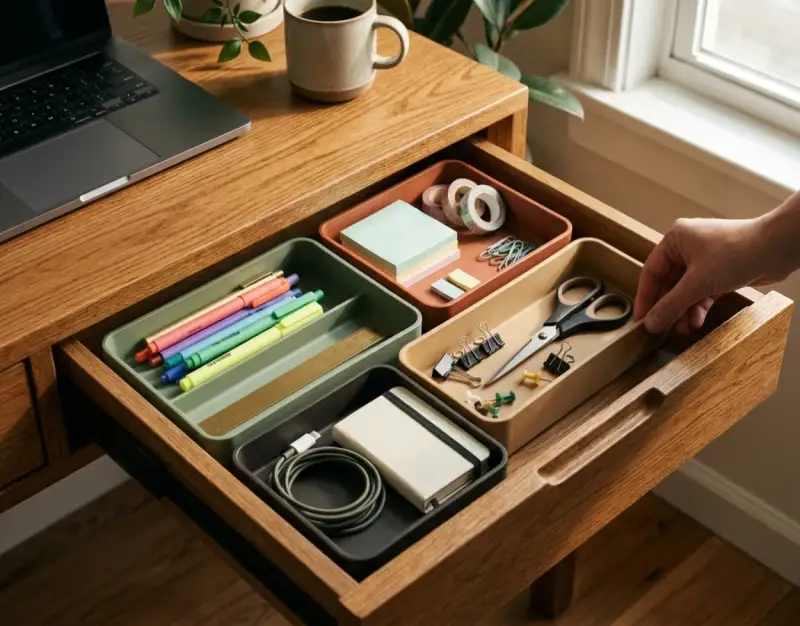
The modern knowledge worker spends an average of 8.5 hours a day tethered to a desk, yet the physical architecture of that workspace is frequently plagued by a silent productivity killer: micro-clutter. While vast amounts of digital ink have been spilled optimizing monitor heights, mechanical keyboards, and cable routing channels, the interior topography of the office desk drawer remains a chaotic abyss. Paperclips, dead-battery thumb drives, tangled charging cables, sticky notes, and half-used pens coalesce into a geological stratum of distraction. When you open a drawer and are met with visual noise, your cognitive load spikes before you even touch a tool. This friction is entirely avoidable through the strategic deployment of a high-performance **desk drawer organizer** system.
Industry trends over the last three years have shifted decisively toward intentional minimalism and micro-zoning. As remote and hybrid work models merge home and professional environments, the demand for a **clean workspace setup** has evolved from an aesthetic preference into a cognitive necessity. Clutter breeds cognitive fatigue; research in environmental psychology consistently demonstrates that visual disarray directly impairs working memory and executive function. What has fundamentally changed is our understanding of modularity. Fixed-grid plastic trays molded in the 1990s no longer suffice for a workspace that must pivot between analog journaling, digital peripherals, and specialized hardware. Today's professionals require dynamic, repositionable storage architectures that scale with their ever-changing toolkits.
The core thesis of this comprehensive guide is simple: mastering **office supply storage** through four carefully curated modular desk trays will permanently eliminate desktop chaos, streamline your daily workflow, and protect your most valuable asset—your attention span. By treating your desk drawer not as a catch-all junk repository, but as a precision-engineered logistical staging ground, you can completely redefine your relationship with your workspace. In tandem with complementary workspace upgrades like Ergonomic Wrist Rests: 4 Supportive Pads for Pain-Free Typing Sessions, optimizing your immediate physical environment yields compounding returns in both comfort and operational velocity.
Deconstructing Workspace Clutter: The Psychology and Mechanics of Drawer Chaos
The Cognitive Toll of Micro-Disorganization
Every time you open a messy desk drawer to search for a specific pen or adapter, your brain undergoes a micro-stress event known as visual search processing overhead. Unstructured items lack spatial predictability, forcing your visual cortex to scan every square centimeter of the drawer rather than instantly recognizing a designated zone. This continuous micro-distraction chips away at your deep-work reserves. When your **office supply storage** is chaotic, you spend precious cognitive bandwidth managing the physical environment rather than executing high-value tasks.
Furthermore, drawer chaos is self-perpetuating. When a drawer has no structural boundaries, items migrate, stack haphazardly, and jam the sliding mechanism. This physical resistance creates a negative feedback loop: you avoid opening the drawer, which leads to items piling up on top of the desk surface, which in turn degrades your **clean workspace setup**. Breaking this cycle requires interrupting the physical entropy with rigid, modular boundaries that enforce spatial discipline.
The Anatomy of a High-Performance Desk Drawer
To successfully implement a **desk drawer organizer** system, you must first understand the volumetric constraints and dimensional tolerances of your specific furniture. Standard desk drawers typically feature depths ranging from 2.5 inches to 4 inches, with varying widths and lengths. Attempting to organize this space without measuring is the primary reason off-the-shelf organization projects fail. You must map your drawer into three distinct operational tiers: immediate-access zones for daily tools, secondary zones for periodic peripherals, and deep storage for archival supplies.
Modular design is the linchpin of modern drawer management. Unlike monolithic plastic trays that leave awkward dead zones around the edges, modular desk trays allow you to configure layouts tailored to your exact inventory. Whether you are housing precision styluses, flash drives, business cards, or notebooks, individual trays can be shifted, stacked, or locked together to maximize every cubic millimeter of usable space. This adaptability ensures that your storage infrastructure remains resilient as your tool requirements evolve over time.
Tray Archetype 1: The Low-Profile Micro-Tray for Precision Tools
Isolating Small-Format Essentials
The first tier of any effective drawer configuration is dedicated to small-format items that otherwise slip into oblivion. Paperclips, SIM ejector tools, micro-SD cards, USB adapters, and high-end pens require low-profile micro-trays with shallow walls, typically measuring between 0.75 and 1.25 inches in depth. When these items are housed in deep bins, they stack on top of one another, making retrieval an exercise in frustration. Shallow micro-trays present every single item in a single, flat optical plane.
To maximize the utility of these micro-trays, position them in the uppermost sliding tray or the front-most section of your main drawer—the zone your hand naturally falls upon when opened. By anchoring your most frequently deployed writing instruments and digital accessories here, you reduce retrieval time to absolute zero. This frictionless access supports a state of sustained operational flow.
Material Selection and Surface Grip
When selecting micro-trays for office supply storage, material composition matters immensely. Flimsy injection-molded plastics flex, warp, and slide around every time you open and close the drawer, generating an annoying rattling sound. Premium modular trays utilize dense, weighted polymers, anodized aluminum, or sustainably sourced bamboo lined with silicone or felt bases.
A non-slip interior lining is particularly crucial for a **desk drawer organizer** system. When you slide the drawer open with momentum, unlined trays allow micro-tools to slide, rattle, and jam against the rear wall. Felt or silicone interiors cushion your gear, protect premium finishes on high-end writing instruments, and keep every component locked firmly in its designated coordinate.
Tray Archetype 2: The Variable-Depth Cable and Peripheral Crate
Taming Modern Tech Accessories
Modern desks are plagued by cable clutter—not just on the surface, but inside the drawers as well. Charging bricks, braided USB-C cables, dongles, earbuds, and portable power banks take up irregular, bulky volumes that defy standard stationery organization. If you manage your digital peripherals poorly, your clean workspace setup is constantly undermined by the tangled nest lurking just beneath the desktop.
You need variable-depth peripheral crates featuring adjustable dividers. These specialized modular desk trays allow you to customize compartment widths on the fly, accommodating a bulky multi-port GaN charger in one slot while maintaining a narrow channel for rolled-up auxiliary cables right next to it. By co-locating all power and connectivity accessories into a single dedicated drawer zone, you establish a command center for your hardware ecosystem.
Strategic Co-Location for Portable Workflows
For professionals who frequently transition between remote environments, desk drawers often double as a launching pad for mobile gear. Much like packing specialized travel gear—similar to the organizational efficiency required when utilizing Zip-Compression Packing Cubes: How to Pack Two Weeks in-a-Carry-On—your desk drawer must allow for rapid deployment and stowing of mobile essentials. Designating a specific peripheral crate for portable mice, presentation clickers, and travel dongles ensures you can pack your bag in seconds without leaving critical tech behind.
Furthermore, keeping your tech accessories neatly divided prevents charging cables from knotting around stationery items. There is nothing more disruptive to deep work than spending five minutes untangling a braided USB-C cable that has formed a complex mechanical knot with a paperclip container. Rigid peripheral crates eliminate this friction entirely.
Tray Archetype 3: The Stackable Document and Notebook Tray
Vertical Space Reclamation
Most desk drawers suffer from a profound spatial oversight: users focus exclusively on two-dimensional floor space while completely ignoring vertical clearance. Standard desk drawers often have 3 to 4 inches of vertical room, yet people place flat trays inside them and leave the upper 2 inches as dead air. Stackable document and notebook trays solve this geometrical inefficiency by introducing multi-tiered vertical architecture.
By utilizing stackable modular desk trays, you can house active project notebooks, legal pads, stamps, and envelopes on the bottom tier while resting a secondary shallow tray directly above them for frequently used flat items like index cards, sticky notes, and letter openers. This doubles your storage capacity without requiring a larger desk footprint, keeping your office supply storage exceptionally dense and organized.
Paper Management and Analog Workflow Integration
Even in a paperless office, physical note-taking remains a vital cognitive tool for brainstorming and wireframing. However, loose papers sliding around the bottom of a drawer quickly turn dog-eared and unpresentable. A dedicated flat document tray keeps incoming mail, contract drafts, and notebooks pristine and pressed.
When organizing your paper storage tier, establish a strict processing cadence. The bottom stackable tray should serve as an intake zone for items requiring action, while a secondary slot holds clean, blank notebooks. Maintaining this physical hierarchy ensures your desk drawer organizer supports both digital and analog productivity without missing a beat.
Tray Archetype 4: The Custom-Configurable Utility Bin
Adapting to Irregularly Shaped Objects
Every professional has specialized tools that defy standard categorization—staplers, tape dispensers, highlighters, correction fluid, reading glasses, or USB audio interfaces. Attempting to force these items into rigid, pre-molded compartments results in wasted space and frustration. The final component of a master-class desk drawer setup is the custom-configurable utility bin featuring interlocking grid walls.
These utility bins feature slitted interior walls where users can insert movable dividers to create custom compartment geometries tailored to their exact inventory. If you acquire a new wireless mouse or a specialized ergonomic stylus, you simply pop out a divider and reconfigure the bin in seconds. This absolute adaptability ensures your **desk drawer organizer** remains relevant year after year, regardless of how your hardware stack evolves.
Integrating Audio and Peripheral Gear
For creators and audiophiles, desk drawers frequently house specialized adapters, microphone accessories, or compact streaming controllers. Just as you might integrate legacy gear into a modern setup using tools like Bluetooth Audio Receivers: How to Turn Any Vintage Speaker Into a Wireless Sound System, organizing your miscellaneous desk gear requires purpose-built modular trays that keep specialized inputs secure, clean, and immediately accessible.
Utility bins prevent rolling objects like markers and lip balms from slamming against drawer walls every time the desk is bumped. By securing every stray item in a dedicated, custom-sized slot, you eliminate the sensory friction of a rattling, disorganized drawer.
Step-by-Step Implementation Blueprint for Your Clean Workspace Setup
``` +-------------------------------------------------------+ | DRAWER ORGANIZATION FLOW | +-------------------------------------------------------+ | v +-------------------------------------+ | 1. TOTAL EXTRACTION & DEEP CLEANING | +-------------------------------------+ | v +-------------------------------------+ | 2. CATEGORICAL AUDIT & PURGE | +-------------------------------------+ | v +-------------------------------------+ | 3. ZONE MAPPING & TIER ASSIGNMENT | +-------------------------------------+ | v +-------------------------------------+ | 4. MODULAR TRAY INTERLOCKING | +-------------------------------------+ | v +-------------------------------------+ | 5. MAINTENANCE & MONTHLY AUDITS | +-------------------------------------+ ```Phase 1: Total Extraction and Surface Decontamination
You cannot organize chaos; you must first eliminate it. Begin your drawer transformation by completely emptying every item onto your main desk surface. Do not skip this step. Once the drawer is entirely bare, take a microfiber cloth and an appropriate surface cleaner to wipe away the accumulation of dust, eraser shavings, and crumbs that invariably collect in the corners.
Inspecting the bare drawer allows you to assess its true interior dimensions accurately. Measure the length, width, and clear vertical height with a precision tape measure. Note any obstructions such as drawer slides, locking mechanisms, or power grommets that might interfere with tray placement.
Phase 2: Categorical Audit and Ruthless Purging
With your inventory spread before you, sort every item into four distinct functional categories: Daily Essentials, Periodic Peripherals, Archival Supplies, and Trash. Be ruthless during this audit. If you have not used a specific branded thumb drive, promotional pen, or instruction manual in the last six months, recycle it or relocate it to a long-term storage closet.
The goal of a **desk drawer organizer** is not to store more items; it is to reduce friction by housing *only* the tools necessary for high-performance work. By purging redundant office supply storage clutter, you free up valuable volumetric capacity for high-priority gear.
Phase 3: Modular Layout Engineering and Interlocking
Place your modular desk trays into the empty drawer without securing them permanently yet. Experiment with different configurations to find the optimal ergonomic balance. Place your micro-trays for writing instruments in the primary strike zone, your cable crates along the flanks, and your stackable document trays in the rear or side sections.
Once you have achieved a layout that feels natural and fluid, engage the interlocking mechanisms of your modular trays. If your trays do not snap together physically, use heavy-duty double-sided museum putty or silicone gel pads beneath each tray to anchor them permanently to the drawer floor. This prevents the trays from shifting when the drawer is operated with force.
Real-World Case Studies & Scenarios: Success vs. Failure
Case Study A: The High-Velocity Financial Analyst
Marcus, a senior financial analyst at a Manhattan investment firm, suffered from chronic desk clutter. His primary desk drawer was a chaotic landfill of rubber bands, broken mechanical pencils, business cards, and three different charging cables for his corporate phone. Every time he needed to sign documents or swap peripherals, he wasted precious minutes hunting for tools.
The Transformation: Marcus implemented a four-tier modular desk tray system. He dedicated a shallow micro-tray to high-end pens and precision correction tools, a variable-depth crate to his lightning and USB-C cables, and a stackable tray for active client folders. Within 48 hours of establishing this office supply storage protocol, Marcus reported a noticeable reduction in daily workplace frustration, estimating he reclaimed roughly 15 minutes of productive focus time every single day.
Case Study B: The Disorganized Creative Agency Director
Sarah, a creative director, attempted to organize her studio desk using a single, cheap, monolithic plastic drawer divider purchased from a big-box retailer. Because the plastic insert did not match her drawer dimensions, a massive 3-inch dead zone formed along the right flank. Within weeks, loose paperclips and flash drives migrated into this gap, jamming the drawer mechanism so severely that it eventually popped off its ball-bearing slides.
The Lesson: Monolithic, non-adjustable plastic inserts fail because they ignore dimensional variations and inventory changes. Sarah eventually replaced the broken insert with interlocking modular desk trays that custom-fit her exact drawer perimeter and accommodated her specific creative tools without dead zones. The lesson is unequivocal: modularity and precise measurement are mandatory for long-term organizational stability.
Critical Mistakes to Avoid When Organizing Your Desk Drawer
1. Buying Organizers Before Measuring the Interior Dimensions
The most common and costly mistake is purchasing a desk drawer organizer based purely on aesthetic appeal online without measuring the drawer's interior length, width, and clearance height. A tray that is a quarter-inch too wide will prevent the drawer from closing entirely, rendering the setup useless.
Countermeasure: Always measure your drawer interior twice using a rigid tape measure, accounting for internal structural lips, screws, or drawer slides before selecting your modular trays.
2. Over-Indexing on Deep Bins and Ignoring Vertical Space
Using deep, single-layer bins forces you to stack items vertically inside the bin itself, destroying visibility and burying frequently used tools beneath layers of clutter.
Countermeasure: Prioritize shallow micro-trays for daily essentials and utilize stackable multi-tiered trays to maximize vertical clearance without creating deep, unsearchable storage pits.
3. Failing to Anchor Modular Trays to the Drawer Floor
Placing unweighted, unanchored plastic trays into a smooth wooden drawer guarantees that the trays will slide, rattle, and misalign every time the drawer is opened or slammed shut.
Countermeasure: Use interlocking tabs, heavy-duty silicone gel pads, or museum putty beneath each tray to lock them permanently to the drawer floor.
4. Storing Archival or Infrequent Items in the Primary Strike Zone
Housing rarely used items—like spare stapler refills, tax documents from three years ago, or holiday greeting cards—in the front-most section of your main desk drawer crowds out your essential daily tools.
Countermeasure: Strictly reserve the primary strike zone for daily essentials. Move archival supplies to deep storage, secondary filing cabinets, or the very rear of the desk drawer.
5. Neglecting Regular Maintenance and Purging Cycles
Even the most pristine office supply storage system will gradually accumulate stray items, paper scraps, and obsolete tech accessories if left unmonitored.
Countermeasure: Establish a bi-weekly 5-minute reset ritual where you empty minor debris, return misplaced tools to their exact modular tray coordinates, and re-evaluate your inventory.
Comprehensive Comparison Table: Drawer Organization Approaches
| Approach / System | Flexibility & Modularity | Spatial Efficiency | Durability | Best Suited For |
|---|---|---|---|---|
| Monolithic Plastic Insert | Low (Fixed grids) | Poor (Creates dead zones) | Low (Cracks under stress) | Basic, unchanging stationery storage |
| Modular Interlocking Trays | High (Fully repositionable) | Excellent (Zero wasted space) | High (Dense polymers / bamboo) | Modern professionals & mixed toolkits |
| Custom Foam Cutouts (Kaizen) | Zero (Permanent fit) | Maximum precision | Very High | Specialized tech gear, tools, & cameras |
| Ad-Hoc Small Boxes / Tins | Medium (Movable, unlinked) | Moderate (Awkward shapes) | Variable | Temporary setups or low-budget fixes |
Frequently Asked Questions (FAQ)
What is the absolute best material for modular desk trays?
The ideal material depends on your aesthetic preferences and the specific tools you store, but weighted polymers, anodized aluminum, and sustainable bamboo lined with silicone or felt represent the gold standard. Solid polymers and bamboo offer superior structural rigidity, ensuring the tray walls do not flex or bow under pressure. Furthermore, interior felt or silicone linings protect delicate finishes on premium writing instruments, eliminate rattling sounds when opening the drawer, and provide non-slip friction that keeps every item securely anchored in its modular coordinate.
How do I stop my desk drawer organizer trays from sliding around?
Unanchored trays shift whenever the drawer is operated with momentum. To eliminate this movement completely, avoid relying solely on gravity. Use interlocking clips if your modular system provides them, or apply heavy-duty double-sided museum putty, clear silicone gel pads, or Velcro strips to the underside of each tray. This bonds the trays firmly to the floor of your desk drawer while still allowing you to lift and reconfigure them whenever your office supply storage needs evolve.
How can I organize charging cables and tech adapters inside a shallow drawer?
Charging cables and adapters require specialized variable-depth crates featuring adjustable divider walls. Avoid winding cables into complex, tight knots, which damages the internal copper wiring over time. Instead, use a neat over-under coil or secure them with silicone cable ties before placing them upright or flat within dedicated narrow channels in your modular tray. Co-locating all power accessories into a single peripheral crate ensures your clean workspace setup remains pristine both above and below the desktop.
How often should I audit and reorganize my desk drawer?
Even a well-designed workspace storage system requires occasional maintenance to prevent micro-clutter from creeping back in. Establish a bi-weekly 5-minute reset ritual where you quickly wipe out dust, return misplaced items to their designated modular trays, and evaluate whether your current tool layout still supports your active workflow. A bi-weekly micro-audit prevents clutter from compounding into a major operational distraction.
Can I mix different brands of modular desk trays in one drawer?
Mixing different brands of modular desk trays can be challenging unless they share standardized dimensional increments (such as multiples of 1 inch or 3 inches). If brands use incompatible sizing grids, you will inevitably end up with awkward dead zones around the perimeter where items get trapped. For the cleanest aesthetic and the tightest spatial efficiency, stick to a single, cohesive modular system designed to interlock or tessellate seamlessly across standard drawer dimensions.
Strategic Roadmap and Final Takeaway
Mastering your physical workspace is not an exercise in superficial neatness; it is a foundational investment in cognitive clarity and professional velocity. By moving away from unstructured junk drawers and adopting a precision-engineered desk drawer organizer system built upon four versatile modular tray archetypes, you eliminate the micro-frictions that drain your daily focus. Your office supply storage transforms from a chaotic liability into a frictionless operational staging ground.
Looking ahead over the next 2 to 5 years, workspace ergonomics will increasingly merge digital peripheral management with physical tool storage. As modular hardware, wireless charging integrations, and bespoke desk accessories continue to evolve, the ability to rapidly adapt your physical storage infrastructure will become a mandatory skill for high-performing knowledge workers. Take action today: measure your drawer, purge your inventory, lock in your modular trays, and enjoy the enduring benefits of a truly clean workspace setup.
Be the first to share a gentle reflection on this story.